






At COP30, Guyana’s climate story is being told by its own experts

By Danielle Swain in Belém, Brazil
danielle@newsroom.gy
“The forest is part of our life. It’s in our DNA.” Derrick John, Toshao of Moraikobai and Chair of Guyana’s National Toshao’s captured the sentiment guiding Guyana’s presence at COP30 in Belém, Brazil, where the climate summit enters its final days on Friday.
COP30 has unfolded with its usual blend of urgency and ritual. Delegates speed-walk between crowded hallways, juggling coffee cups, briefing notes and back-to-back side events. But beneath this diplomatic choreography, Guyana’s climate story has been asserting itself, shaped by the people who live the consequences of climate change every day.
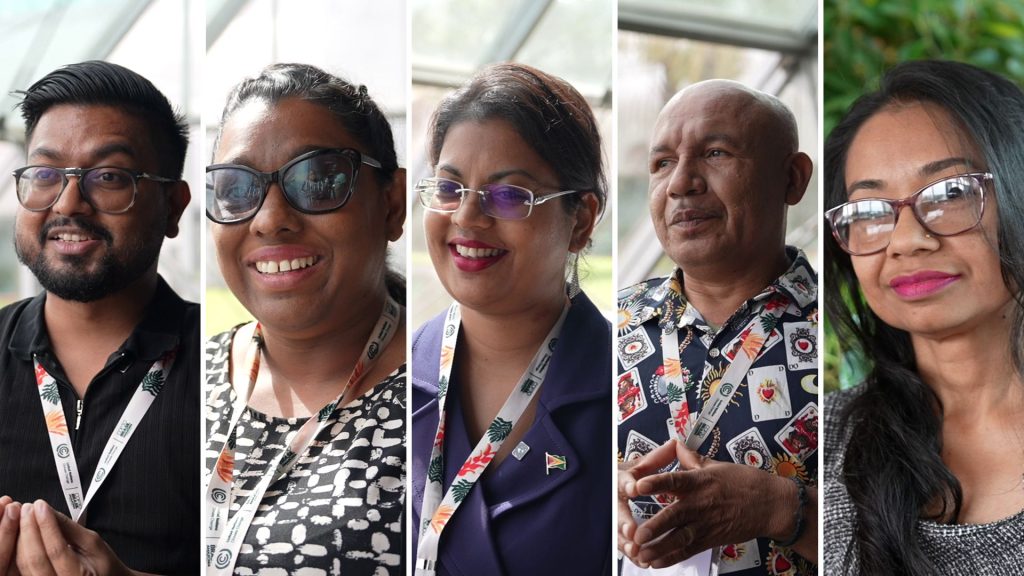
Unlike many small states that rely heavily on foreign advisers to interpret complex climate policy, Guyana has chosen to feature its own local expertise. The small team presenting the country’s approach to forest protection and climate finance is made up of Indigenous leaders, environmental economists and homegrown scientists who helped build the systems now drawing international attention.

Together, they form the backbone of Guyana’s presence in Belém, reminding the conference that effective climate policy is strongest when led by the people closest to the land.
“We know what has worked, what hasn’t”
Dr. Pradeepa Bholanath, Guyana’s Senior Director for Climate and REDD+, moves through the conference hall with the calm of someone accustomed to stitching large, unwieldy ideas together. She trained as an environmental economist in the United Kingdom, but her work representing Guyana’s positions at global climate negotiations, feels like bringing that training home.
“Environmental economics is about finding a balance between development and conservation,” she said, pausing between panels. “Seeing that come to life in the LCDS and representing our country here, it’s an honour.”

Her voice, firm and undecorated, carries the weight of someone who has grown with the policy she defends. The Low Carbon Development Strategy (LCDS), once a fragile idea, is now a template for how small nations, forested or not, can hold their ground in a global system that often expects them to fail.
“It’s crucial to bring the local context,” she added. “We’ve lived this experience for almost 20 years. We know what has worked, what hasn’t.”
Outside the pavilion, rainclouds from the Amazon drift low. Inside, Dr. Bholanath prepares her team for the next negotiation.
Climate change as a lived reality, not a conference debate
Across the pavilion, Lucina Singh talks about climate adaptation with a delegate. She grew up loving biology, and the fascination never left her.
“I like understanding ecosystems,” she said. “How things connect, and how humans influence them.”
This is her second COP, but her responsibilities are anything but junior. Singh is helping finalise Guyana’s first national adaptation plan, an effort that stretches across health, education, agriculture, biodiversity, and water. Her job, as she sees it, is not just to follow global expectations but to prepare her country for what climate change will force upon it.
“We’re a small country, but we’ve done so much,” she said.

The words are shaped by the knowledge that Guyana’s climate leadership didn’t materialise overnight, it was built, often painstakingly, by people like her.
Beside her, Raja Gokul, a climate coordinator with the Department of Environment and Climate Change (DECC), talks about discovering climate change during an environmental chemistry course.
“For me, it was the biggest problem the world was facing,” he said. “I wanted to be part of the solution.”
Now he represents Guyana’s LCDS, a strategy he describes as “widely respected”, a phrase that is less boastfulness and more acknowledgment of hard-fought credibility.

Indigenous leadership at the negotiating table
But the most striking presence in Guyana’s technical core may be Toshao Derrick John.
In a field where Indigenous knowledge is often referenced but seldom centred, his voice has weight.
“Forest is a global asset,” he said. “And for Indigenous people, it’s part of our life. It’s in our DNA. If anything concerns forests, our voices must be part of the decision.”
For him, standing in the Amazon, the world’s largest rainforest, carries its own symbolism.

“It gives me a sense of ownership,” he said. “Growing up in the jungle and being here, at COP30, in the heart of the Amazon, it means everything.”
His perspective is shaped by decades of advocating for communities once isolated from national decision-making. “Things have changed,” he said. “Indigenous people have a seat at the highest level now. It’s something I’m proud of.”
A small state shaping global climate work
At one of the side events, Preeya Rampersaud explains Guyana’s global role with the clarity of someone who has had to defend it often.
“Guyana isn’t just talking about climate action, we’re leading it,” she said proudly. “Our experience in forest conservation and carbon markets is inspiring action globally.”

Her role, supporting the Guyana Co-Chair of the Forest & Climate Leaders’ Partnership, brings her into rooms where the decisions of 40 governments collide. It is a job that would seem outsized for a country of Guyana’s population, unless one understands how deeply prepared the team behind ‘the land of many waters’ is.
A different kind of climate story
At COPs, climate narratives are often framed in grand terms, megafauna, megaprojects, global tipping points. Guyana’s story is more intimate. It is a story of people who grew up near rivers and forest trails, who discovered climate change in classrooms and laboratories, and who now find themselves at the centre of global negotiations for their country.
They are not visiting experts.
They are not consultants passing through.
They are Guyanese who know the forest not as theory, but as home.
And at COP30, that may be the most radical but necessary message of all.
Missing Anna Catherina woman found dead at Stewartville seawall
Daniel Persaud is UG’s 2025 Valedictorian
Related Articles
 President pledges further support for Dharm Shala
Elderly citizens and vulnerable residents at the Dharm Shala in Albouystown, Georgetown, were overjoyed to be served lunch on Thursday...
 President Ali gifts Enterprise family new home for Christmas
In the spirit of goodwill and compassion, President Dr Mohamed Irfaan Ali handed over a newly constructed home to James...
 Agri. Minister responds to allegations made in Facebook video
See below the full statement from the Minister of Agriculture, Zulfikar Mustapha: I note with profound concern several Facebook posts...