






GECOM to fill several senior vacancies as funds budgeted for local government elections this year


The Guyana Elections Commission (GECOM) is expected to fill several senior vacancies even as provisions have been made in its 2026 budget for the hosting of Local Government Elections later this year.
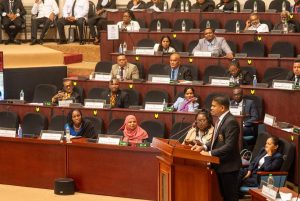
The disclosure was made on Monday during the consideration of the 2026 budget estimates in the Committee of Supply of the National Assembly, as parliamentarians examined allocations for constitutional agencies.
During the engagement, questions were raised by opposition members about the absence of key senior personnel, including the positions of Deputy Chief Elections Officer (DCEO) and Assistant Chief Elections Officer (ACEO).
In response, Minister of Governance and Parliamentary Affairs Gail Texeira confirmed the salary scales for the vacant posts, noting that the Deputy Chief Elections Officer carries a monthly basic salary of $1,320,274, while the Assistant Chief Elections Officer attracts a monthly salary of $943,585.
Further questions were asked about other senior-level vacancies at the commission.
It was disclosed by Ms. Texeira that additional vacant positions include Legal Officer, Information Technology Manager, Research Officer, Security Manager and Chief Accountant.
Meanwhile, the government confirmed that GECOM’s budget includes provisions to support the staging of Local Government Elections in 2026.
Teixeira explained that allocations were made for the hiring of temporary election-day staff, procurement of election materials, printing, transportation, training of staff and payments for scrutineers.
She noted that while the allocation for the commission may be slightly lower than in the previous year, the difference is not significant when compared to the higher cost of General and Regional Elections.
Teixeira also pointed out that some materials were purchased last year and will roll over into 2026, reducing the need for certain expenditures this year.
During the sitting, questions were also raised about the possible introduction of biometrics at polling stations to improve transparency and scrutiny during elections.
However, Teixeira said such a move would require a decision by the elections commission and, if approved, additional funding would have to be provided through a supplementary allocation.
Parliamentarians also questioned whether GECOM has sufficient materials to produce national identification cards.
Teixeira responded that the commission has indicated it has enough supplies to issue ID cards throughout 2026. She noted that during continuous registration, GECOM processed 12,387 new registrants and is projecting as many as 30,870 registrants for 2026.
The opposition MPs also touched on the government’s planned National Electronic ID (e-ID) system, with Teixeira clarifying that the new electronic ID card will not replace GECOM-issued ID cards for elections, at least not for the upcoming Local Government Elections.
She explained that the electronic ID card is intended to store a wider range of information, including medical records, licences and other personal data, and would take time to fully implement.
Teixeira added that while the system is voluntary at this stage, it could become increasingly necessary over time as more services transition to digital access. However, she stressed that safeguards must be in place to ensure citizens are not discriminated against or denied access to essential services such as healthcare and education if they do not yet possess the electronic ID card.
Related Articles
 $75M budgeted for President’s Youth Advisory Council as opposition questions performance measures
A total of $75 million has been allocated to the President’s Youth Advisory Council in the 2026 national budget, drawing...
 With almost $1B more for MoM, Teixeira says ‘slow turn’ seen in...
Consideration of estimates for the 2026 national budget began on Monday in the Committee of Supply in Guyana’s National Assembly,...
 $34.6M allocated to Office of Leader of the Opposition under 2026 budget
Consideration of the 2026 budget estimates continued on Monday in the Committee of Supply of the National Assembly, moving on...