





Guyana’s digital forest: How a small state is using AI to lead a global green revolution

By Danielle Swain
Belém, Brazil
danielle@newsroom.gy
When Pradeepa Bholanath stepped onto the stage at COP30 in Belém, Brazil, the Senior Director for Climate Change in Guyana’s Ministry of Natural Resources wasn’t unveiling a new forest pact or a billion-dollar pledge. Instead, she described something less flashy but far more radical, how a small South American nation is using artificial intelligence and digital innovation to protect one of the world’s most intact rainforests.

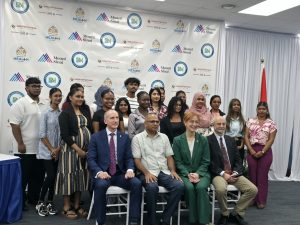
At the session titled “Live Canopy: Harnessing AI and Digital Innovation for Forest Conservation and Reforestation,” hosted by the Tony Blair Institute for Global Change, Guyana’s model of technology-driven forest governance took centre stage. The event, held inside the Forest Pavilion at COP30, coincided with the release of the Live Canopy report, a detailed study on how AI, remote sensing, and data systems are reshaping forest management worldwide.
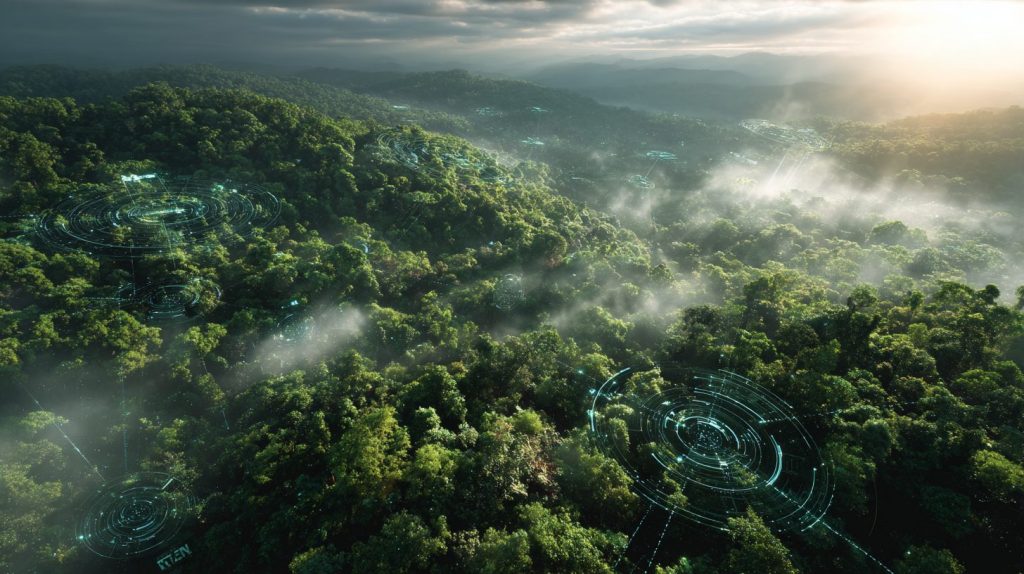
Guyana’s digital forest
For Guyana, the move toward digital monitoring was never just about innovation, it was about survival. Much of the country’s 18 million hectares of rainforest lies deep in the interior, far from roads or rivers. “Technology became a necessity,” said Pradeepa Bholanath, Senior Director for Climate Change in the Ministry of Natural Resources. “Half of our forests are in areas you simply can’t reach. Satellite systems allow us to see what’s happening in real time, even in the most remote corners of Guyana.”
That necessity birthed one of the developing world’s quiet success stories. In 2009, Guyana built one of the first national Measurement, Reporting, and Verification (MRV) systems under its forest partnership with Norway, a system that has delivered 15 consecutive years of transparent, digital forest monitoring.
“This is how small states can lead globally,” Bholanath said, “by embedding technology within sustainable forest governance and using data not just to report on the forest, but to protect it.”
Carbon to biodiversity
At the session, Bholanath revealed how Guyana’s Low Carbon Development Strategy 2030 (LCDS 2030) has turned its forest data into a cornerstone of environmental policy. The country’s MRV platform is now being expanded to track biodiversity indicators, creating a digital backbone for the recently launched Global Biodiversity Alliance, a multilateral initiative spearheaded by President Dr Irfaan Ali in Guyana earlier this year.
“We’re moving beyond carbon,” she said. “The same systems that monitor emissions can also help us report on species, water, and community safeguards. That’s the future of climate accountability.”
AI meets inclusion, the view from Brazil
Panelists from Brazil echoed and expanded on Guyana’s message, underscoring that technology alone will not save the world’s forests.
André Aquino, Head of the Special Economic Advisory Office at Brazil’s Ministry of Environment and Climate Change, emphasized that simplicity and inclusivity must remain central to innovation. “We can’t afford to make systems so complex that countries can’t use them,” he warned. “AI must accelerate capacity-building, not replace it.”
Raul Protázio Romão, Secretary of Environment and Sustainability for the State of Pará, reminded the audience that the forest agenda “cannot be carbon blind.” Conservation, he said, must include social and bioeconomic benefits for the people who live within and depend on the forest.
Marianna Budaragina, Senior Climate Finance Advisor at the Tony Blair Institute, introduced the Live Canopy report’s “Digital Tree Framework”, which maps how technologies like AI, satellite sensing, and data-sharing can strengthen every layer of forest action, from the “roots” of connectivity and governance to the “canopy” of biodiversity and restoration. “Technology can empower decision-makers,” she said, “but it can’t replace human stewardship.”
From the technical side, Tasso Azevedo, founder of MapBiomas, explained how machine learning has transformed land-use mapping across Brazil and other global south countries where MapBiomas works. “We now track every 30-by-30-meter pixel of the country, year after year,” he said, noting that his team retrains models annually to refine accuracy. “AI helps us move fast, but people make the maps real. Without human understanding, the algorithms fail.”

South–South Solutions
If there was a common thread among the panelists, it was that digital innovation must flow both ways, not from North to South, but between nations facing similar challenges.
Bholanath called for deeper South–South collaboration, noting that Guyana is learning from Brazil’s advances in data governance while offering lessons of its own. “The fastest, most cost-effective way forward,” she said, “is to share what already works.”
Azevedo agreed, describing a future in which tropical countries jointly develop tools that reflect their realities , from mapping cattle pastures and soya bean in Brazil to palm oil and rubber trees in Indonesia.
The future, written in code
As COP30 unfolds under Brazil’s presidency, the message from Belém is resounding, digital transformation is no longer theoretical, it is the next frontier of climate action.
For Guyana, that frontier is both technological and moral. The country’s “digital forest dream” is not yet a finished system, but a vision rooted in accessibility, trust, and cooperation. The next phase will depend not only on algorithms and satellites, but on partnerships that make these tools work for everyone.
“Technology should never be an exclusive language,” said André Aquino. “It has to be one that communities, scientists, and policymakers all understand.”
In that sense, Guyana’s journey reflects a larger truth emerging from Belém, that the future of conservation will belong to those who can blend innovation with inclusion.
A small state with a vast forest, Guyana is proving that progress in the digital age is not measured only in data but in how widely that data is shared, and how deeply it serves the people who protect the planet’s forests.

‘Lock up the culprits’- Traffic Chief backs tougher enforcement amid wanton e-cycle misuse
Health Ministry launches recipe book
Related Articles
 More speed cameras go live across Region 3
The Government of Guyana has announced the activation of additional automated speed cameras and radar speed signs across Region 3...
 Gov’t pursuing 15 acres to develop housing scheme at Cane Grove
The government is moving to acquire 15 acres of land at Cane Grove, Region Four, as it advances plans to...
 $75,000 fine for persons who fail to comply with new tint rules
Motorists who fail to meet the new tint standards by the end of 2025 will face immediate testing and hefty...