





To make progress on deforestation at COP30, countries must be paid to keep forests standing


By Dr Mohamed Irfaan Ali
President of the Co-operative Republic of Guyana
Nov 17 (Reuters) – More than 30 years after the world first came together in Brazil to tackle climate change, global temperatures are still rising and so is impatience with talk over action.
Citizens everywhere are asking a fair question: where is the progress?
People want proof that climate action works: that investing in nature creates jobs, strengthens economies and makes communities safer.
At COP30, the question we’re being asked is clear: how can we turn promises into progress?
When it comes to forests, there’s finally a story of real momentum.
For decades, protecting forests felt like an uphill struggle. Now, that’s changing. Forest nations and partners around the world are rewriting the economics of conservation, turning forest stewardship into an engine of prosperity and sustainable growth.
In Guyana, our pioneering system for high-integrity carbon credits has shown how trees can be worth more standing than cut down.
Brazil’s leadership on the new Tropical Forests Forever Facility (TFFF) is creating a predictable, long-term finance reward for countries to preserve their forests and direct proceeds to Indigenous Peoples and local communities. Across the world, investors are beginning to recognise that keeping forests standing is not just good for the planet, it’s good for their bottom line.
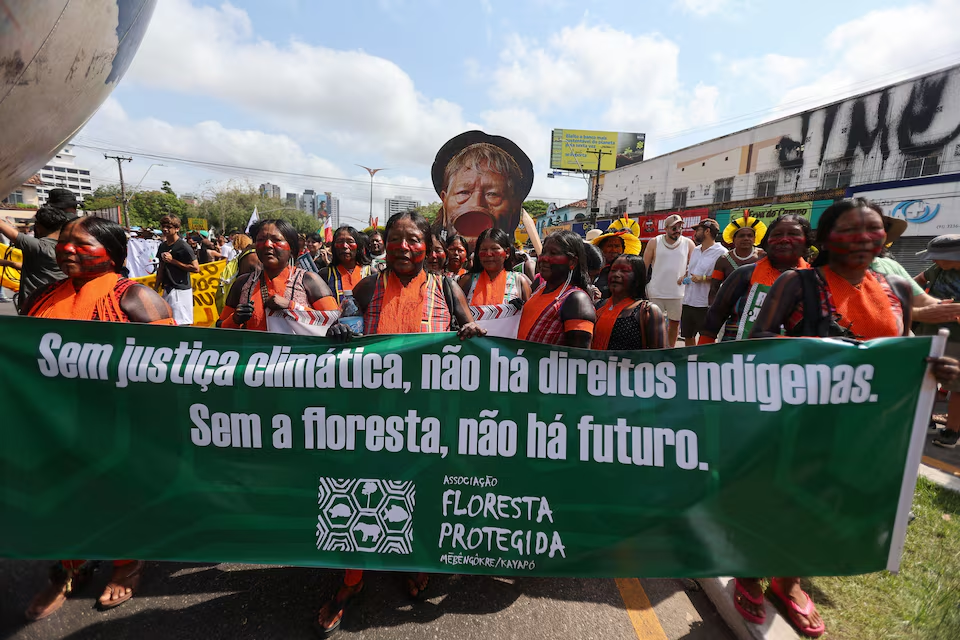
Still, we must go further.
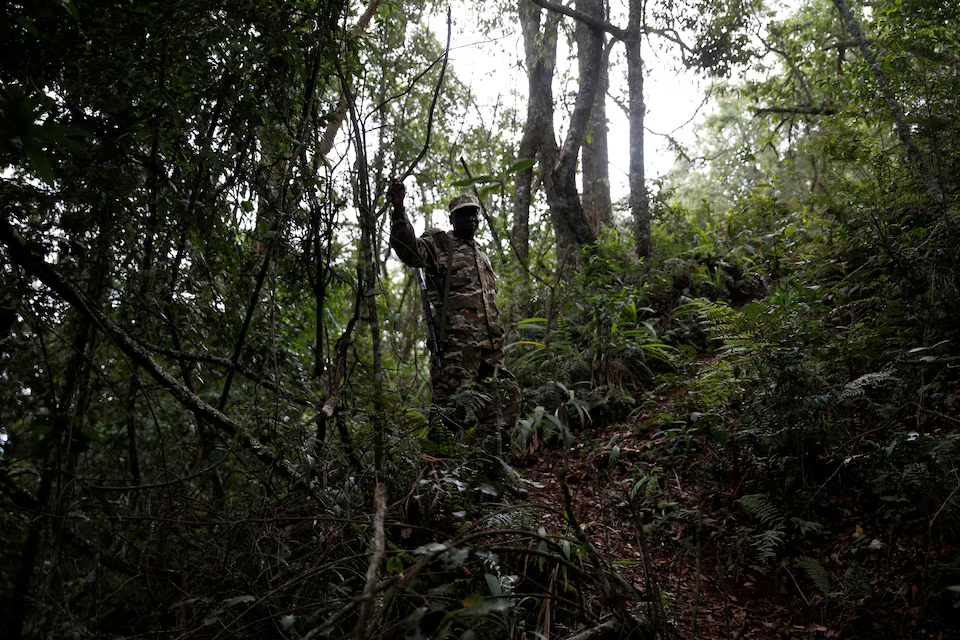
There is no global stability, and no solution to the climate and nature crises, without healthy, thriving forests. Forests absorb nearly one-third of global carbon emissions and sustain four-fifths of life on land, but they receive less than 1% of global climate finance. Preserving tropical forests would cost about $66.8 billion a year – less than the world spends on ice cream – while delivering 20% of the most cost-effective climate solutions available.
Protecting forests requires global collective effort. Far too often, forest-rich countries have shouldered the burden alone, only to be let down by a lack of global support. Countries like Guyana protect global assets that benefit everyone, but the financial support long pledged by the world’s wealthy nations has failed to flow.
To address this imbalance and close the forest finance gap, the Forest & Climate Leaders’ Partnership (FCLP), which I have the honour to co-chair alongside the UK government, has worked with Brazil and the United Nations Environment Programme (UNEP) to develop the Forest Finance Roadmap: a practical plan to close the forest finance gap by 2030 and build a global economy that rewards preservation rather than destruction.
The roadmap identifies six ways to make it pay to keep forests standing.
These include expanding high-integrity carbon markets to unlock up to $6 billion a year for forest nations, fully funding the TFFF to reward the value of standing forests, and accelerating investment in the forest bioeconomy to mobilise a further $15 billion a year while creating green jobs. The roadmap also identifies the opportunities from aligning corporate supply chains with forest goals, managing sovereign debt to service payments to free up $5 billion annually for forests, and reforming agricultural subsidies.
These solutions are already working and growing in momentum.
Silver for Guyana at FIBA Women’s Championship; perfect record for champions Virgin Islands
Guyanese Joy Brown, Amisha Ramlall named in FIBA Women’s All-Star Five
Related Articles
 Gov’t considering railway link from Lethem to the Atlantic coast – President...
President Dr Mohamed Irfaan Ali on Wednesday revealed that the government is examining possible options for the construction of a...
 President pledges G$100,000 cash grant for all adults in 2026 budget, with...
President Irfaan Ali Wednesday night said his government will provide for a cash grant of $100,000 for every citizen aged...
 Online aircraft landing permits improving aviation efforts – Indar
Following the launch of the Guyana Civil Aviation Authority (GCAA) e-services landing permit system, the aviation sector continues to see...